Lecture Series
Heritage Ottawa has lined up an enticing program for our 2026-2027 Free Lecture Series!
We ask that you PRE-REGISTER in advance of each free lecture.
The lectures begin at 7 pm and are presented via ZOOM, unless otherwise indicated, and last approximately one hour.
Note: Several of our lectures are available for viewing on Heritage Ottawa's YouTube channel .
Upcoming Lectures
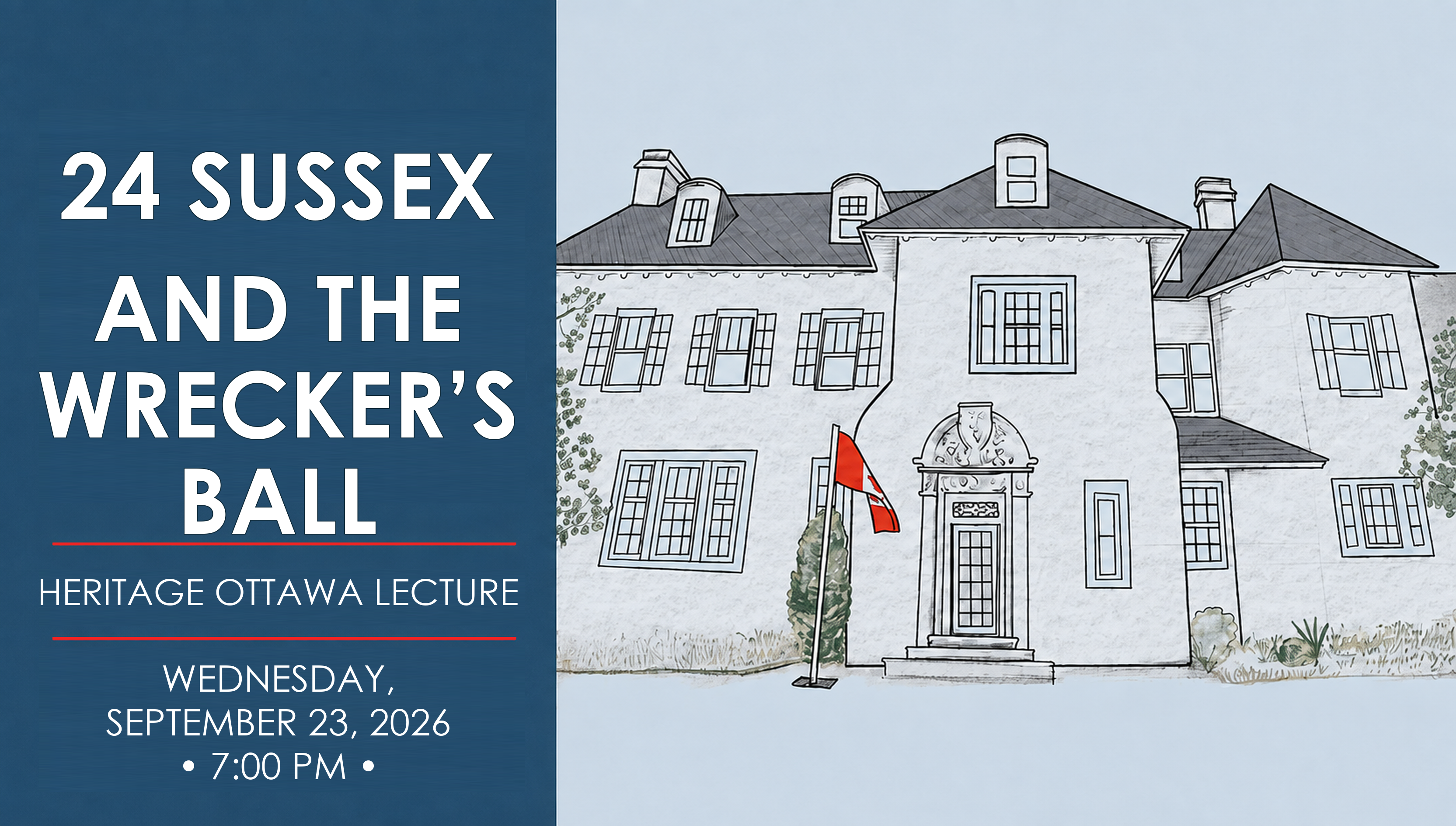
24 SUSSEX AND THE WRECKER'S BALL
Beechwood National Memorial Centre
Sacred Space Room, 280 Beechwood Avenue, Ottawa
Prime Minister Mark Carney's announcement of a design-build competition to “modernize” 24 Sussex Drive has happily rescued the house from a long political limbo that led to its decay. But make no mistake: the existing residence is still in danger.
No guidelines for the project were provided, not even a basic budget, so as to not limit the competition. Will everything but the façade be stripped away, to be replaced by a new structure? Will there be a repeat of the 1950 “restoration,” where the original building was left unrecognizable? And will the limited triangular lot at 24 Sussex be crowded with modern outbuildings?
The official residence has accrued 75 years of rich Canadian history, under the nine prime ministers who lived there. Much of the country’s business was conducted in the dining room, the living room, the sun room and library, where royalty, presidents and world leaders visited. The building that was refurbished and expanded in 1950 was no architectural beacon, but it was stately and reflected ideas of governance in mid-century Canada.
Dean Beeby is co-author (with Ian Bailey) of the recently published 24 Sussex Drive: The Past and Future of Canada's Official Residence (Sutherland House). A veteran investigative journalist in Ottawa, Dean is author of six previous non-fiction books, and is a specialist in freedom-of-information laws. He has worked in Toronto, Halifax and Ottawa for The Canadian Press and for the CBC's Parliamentary bureau.
This lecture will examine what happened inside the walls of 24 Sussex over a tumultuous modern era in Canada. And it will argue that preserving the existing building with only limited additions is properly respectful of a rich history on this special landscape. Grand architectural designs may be appropriate to greenfield sites elsewhere, but the built legacy of 24 Sussex should be largely left alone.
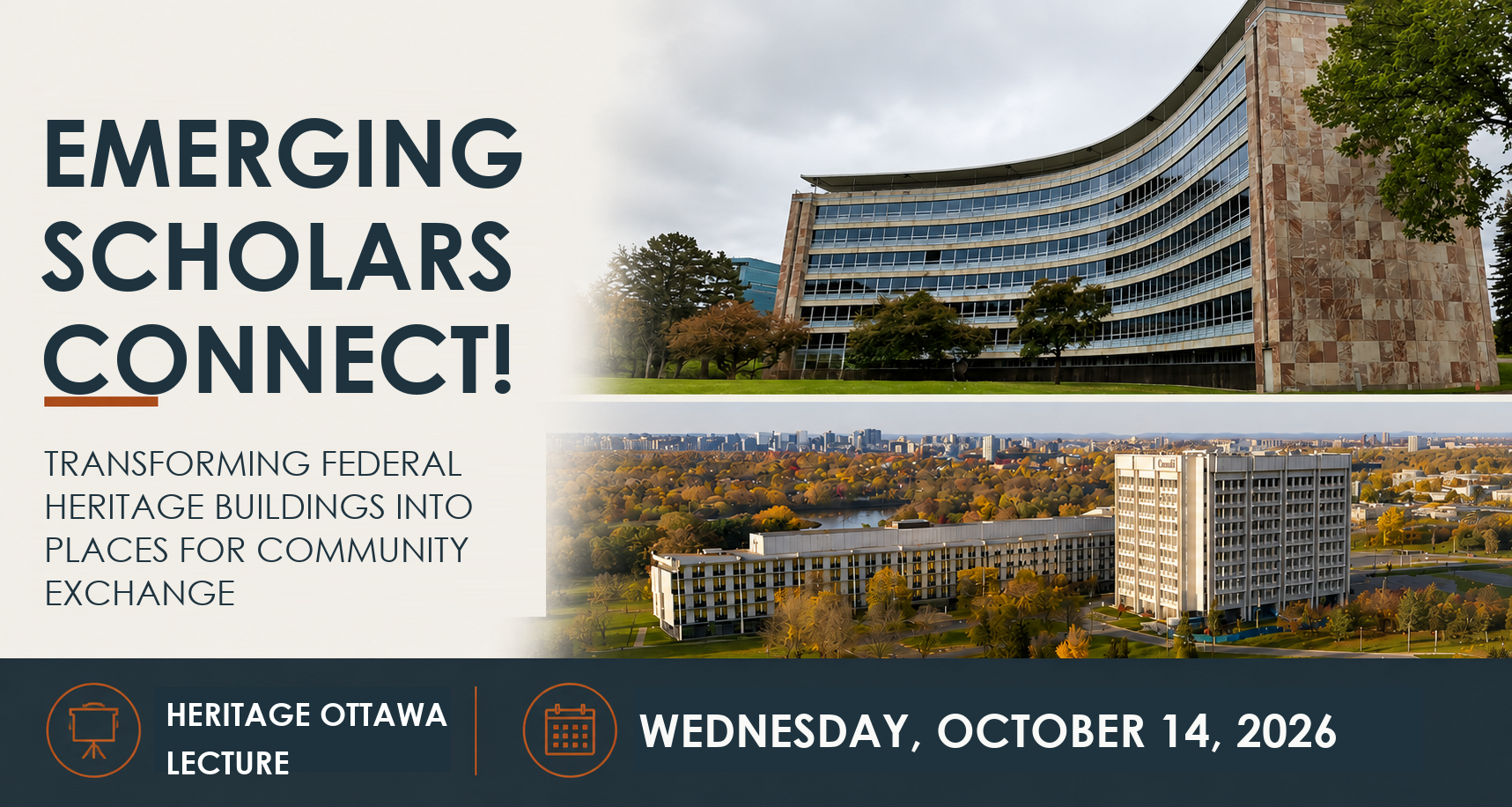
EMERGING SCHOLARS CONNECT! TRANSFORMING FEDERAL HERITAGE BUILDINGS INTO PLACES FOR COMMUNITY EXCHANGE
PRESENTED VIA ZOOM
Led by Carleton University Instructor Lyette Fortin, this third-year Conservation Studio project explores the adaptive reuse of heritage buildings in Confederation Heights, a federally-owned district being transformed from a government employment centre into a vibrant, mixed-use community shaped through collaboration among Indigenous Peoples, public agencies, landowners, and community stakeholders.
The student projects reimagine two designated Modernist heritage buildings—the former headquarters of the Canadian Broadcasting Corporation (CBC) at 1500 Bronson Avenue and the former Department of National Revenue Complex at 875 Heron Road—as dynamic places for cultural exchange, intergenerational living, education, artistic expression, and student housing. Through adaptive reuse, these proposals preserve the buildings’ architectural and historical significance while addressing contemporary community needs: social inclusion, cultural expression, collective memory, and environmental sustainability.
An introduction to the Conservation Studio by Lyette Fortin will be followed by five student presentations each approximately 10 minutes in length.
Moderator: Lyette Fortin, Hon. OAA, is a consultant in architectural conservation with 37 years of leadership in the stewardship of Canada's built heritage. Her career has spanned senior roles with the Government of Canada, the NCC, and the House of Commons of Canada, where she led the conservation, rehabilitation, and long-term strategic planning of some of the country's most significant heritage buildings. Since 2014, Lyette has been an Instructor at Carleton University's Azrieli School of Architecture and Urbanism, teaching philosophy, ethics, and practice of architectural conservation.
Students:
1500 Bronson Avenue: Lillian Chang, Emilie Geve and Kai Marks, Polyphony; Sofia D'Amato, Gathering Resonance.
875 Heron Road: Wangle Goose, Green Meets Grid; Alexia De Tina and Katherine Stuart-Kiss, Pulse; and Jocelyne Leonard and Julia Taylor, Sense: School of Expression in Narrative and Sensory Education.
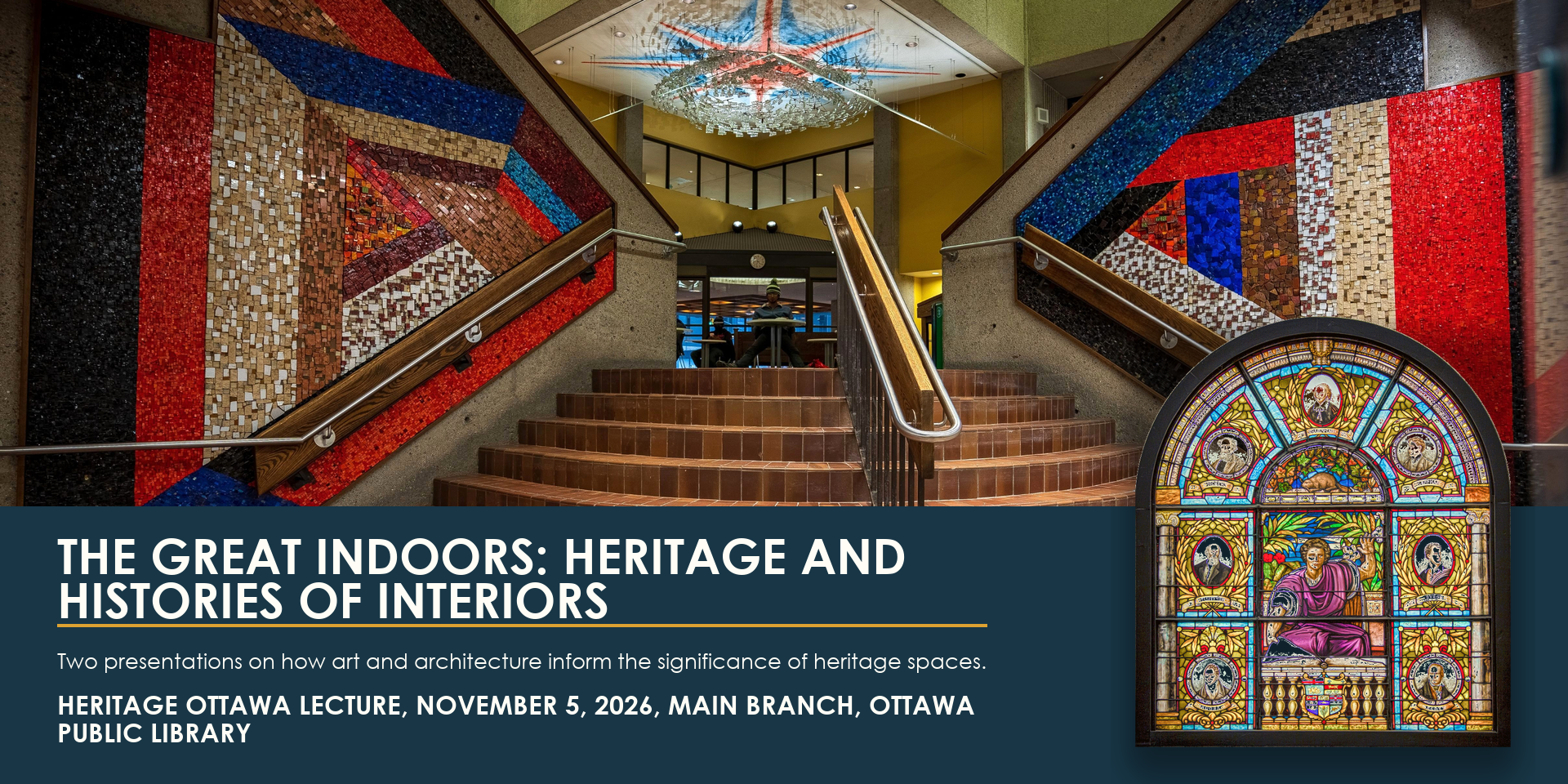
THE GREAT INDOORS: HERITAGE AND HISTORIES OF INTERIORS
OTTAWA PUBLIC LIBRARY, MAIN BRANCH AUDITORIUM, 120 METCALFE STREET, OTTAWA
Join us for two presentations that will explore the relationship between art and architecture and how it informs the significance of heritage spaces.
Salvaged & Relocated: Fragments and Interiors of Ottawa
Ottawa's history of architectural conservation includes striking examples of salvage and relocation, from the stained-glass windows of the former Carnegie Library incorporated into the Main Branch on Metcalfe Street, to the Rideau Convent chapel integrated into the National Gallery of Canada. These practices are increasingly reframed through the lens of the circular economy, where the reuse of building components helps reduce the environmental costs of raw material extraction, demolition waste, and landfill.
Such acts of reuse have sparked renewed interest in the concept of spolia—the re-employment of architectural fragments in new contexts. How should we understand shifting ideas of material and site-specific heritage values in this evolving landscape?
Join architect Susan Ross who will examine Ottawa-based case studies, including the Canadian War Museum’s reuse of copper from the Library of Parliament, the Ottawa International Airport’s incorporation of timber from wartime hangars, and the Ottawa Art Gallery’s staircase from the Firestone House, alongside other examples of salvage and relocation across the city.
Art and Architecture: The Vision and Legacy of Gerald Trottier and the Ottawa Public Library Project
This talk explores the symbiotic relationship between art and architecture through the work and legacy of Ottawa artist Gerald Trottier and its impact on Ottawa's cultural landscape. Highlighting his close collaboration with architects, including Bemi Bemi & Associates and the Ottawa Public Library project, it will examine how space, form, and function unite these creative disciplines.
The presentation by Denise Trottier highlights the artist’s career, and concludes with an overview of the public art collection at the OPL, focusing specifically on Trottier's remarkable mosaic murals and their significance within the city's architectural and artistic heritage.
Susan Ross, OAQ, MRAIC, FAPT, is an architect, educator and academic who is associate professor at Carleton University's School of Indigenous and Canadian Studies, with a cross-appointment to the Azrieli School of Architecture and Urbanism.
Denise Trottier is a former public servant and a lifelong member of Ottawa’s artistic community. The daughter of prominent Canadian and Ottawa artist Gerald Trottier, she grew up immersed in the city’s vibrant arts scene and experienced firsthand her father’s close working relationships with architects, artists, and other colleagues.
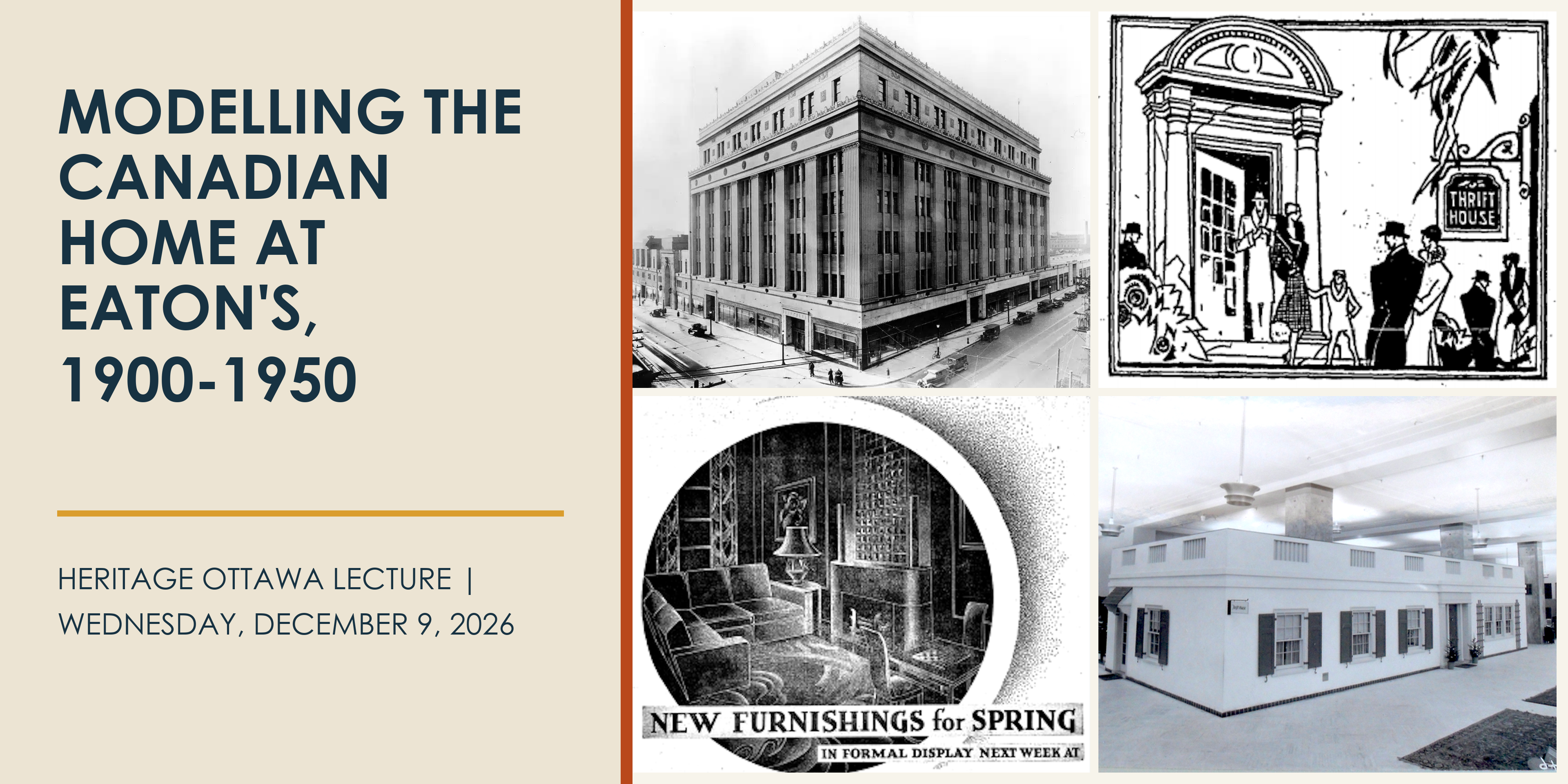
MODELLING THE CANADIAN HOME AT EATON'S, 1900-1950
Beechwood National Memorial Centre, Sacred Space Room, 280 Beechwood Avenue, Ottawa
Why did Toronto’s T. Eaton Company make substantial investments in building elaborate model house displays in its stores during the interwar years?
During the first half of the twentieth century major North American department stores positioned themselves as civic institutions serving not just the material, but also the cultural needs of their local communities. Eaton’s use of life sized house and period room displays to sell furniture while also teaching lessons about middle class domesticity serves as a case study of the marriage of culture and commerce during this period of Ontario’s history.
Light refreshments and a chance to mingle will follow the lecture and Q&A session.
Susan Haight has a PhD in Canadian history from Carleton University and an MA in Victorian Studies from the University of Toronto. Her interest in displays as teaching tools was first sparked by her work in exhibition development at the Royal Ontario Museum and the Canadian Centre for Architecture. Her chapter “Home economies: The T. Eaton Company’s Thrift House, 1926-1950” was published in Architectures of Display: Department Stores and Modern Retail (Routledge, 2018).
Past Lectures
PAST MEETS PLAY: OTTAWA'S HISTORIC SPORT SPACES
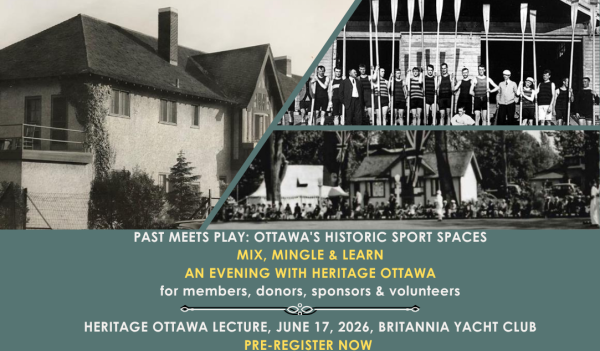
A SPECIAL EVENT IN APPRECIATION OF OUR MEMBERS, DONORS, SPONSORS AND VOLUNTEERS!
Join us for a special evening to Mix, Mingle, & Learn so we can properly thank you, our valued members, donors, sponsors and volunteers for your support of Heritage Ottawa and the work that we do. An illustrated talk, Past Meets Play: Ottawa's Historic Sport Spaces, with guest speakers will follow refreshments.
Britannia Yacht Club, Upper Deck, 2777 Cassels Street, Ottawa. Free parking on site.
Refreshments and time to reconnect begin at 6:30 pm. The lecture follows at 7 pm. This free event is by invitation only. Space is limited so PRE-REGISTRATION is required using the form below.
Be sure to check in upon arrival to pick up your ticket for a complimentary glass of wine, beer or soft drink.
Not a member yet? CLICK HERE to join.
PAST MEETS PLAY: OTTAWA'S HISTORIC SPORT SPACES
Our evening presentations will explore the fascinating history of sports and social clubs in Ottawa through five featured sites: the Champagne and Plant Baths, the Highland Park Lawn Bowling Club, the Ottawa Tennis and Lawn Bowling Club, and the Ottawa Rowing Club.
Heritage conservation consultant Sally Coutts will present on The Champagne and Plant Baths: History and Preservation Efforts. Both facilities opened in 1924 to address the lack of amenities in two predominantly working class wards of the city. The urban reform movement saw a growing interest in improving the lives of the working classes while encouraging cleanliness and healthy recreation. Both facilities are high style structures, providing an impressive civic presence. Sally will share the histories of these significant civic facilities and the efforts made to preserve them.
City of Ottawa Heritage Planners MacKenzie Kimm and Taylor Quibell will focus on the role lawn bowling, tennis and rowing clubs played in Ottawa’s sport and social histories. The clubhouses, boathouses and recreation areas reflect the evolution and rise of the popularity of these sports in Canada, and stand as remnants of the late 19th and early 20th century lifestyles of the emergent middle class. Their presentation will speak to how, through municipal heritage designation, the City is recognizing the importance of these local landmarks and their significance in Ottawa.
Sally Coutts has dedicated more than four decades to heritage conservation, working across federal, provincial, and municipal levels of government. Her career began in rural Alberta, where she managed a grant program aimed at restoring pioneer cemeteries. She later served as an architectural historian for Parks Canada. In 1990, Sally joined the Heritage Section of the City of Ottawa, spending the next 30 years as a heritage planner and contributing to a diverse range of conservation projects. After retiring in 2020, she founded Sally Coutts Heritage Consulting, completing three heritage conservation plans for the City of Ottawa. She now provides heritage planning advice to the Municipality of Mississippi Mills.
MacKenzie Kimm is a Senior Heritage Planner with the City of Ottawa, where she provides conservation expertise on heritage and planning applications, oversees the preparation of Heritage Conservation District Plans, and presents evidence before the Ontario Land Tribunal. She holds a Master’s degree in Architectural Conservation from the University of Edinburgh and in Urban Planning from McGill. As a life-long swimmer, MacKenzie’s love for sports has informed her professional and research interests, including her Master's major research project that examined the conservation of historic sporting facilities in the UK, and working on the designation of the Ottawa Rowing Club.
Taylor Quibell is a Heritage Planner in the Heritage Planning Branch at the City of Ottawa. In this role, she provides technical guidance on conservation projects, processes heritage permit applications, oversees heritage grant programs, and conducts research on heritage buildings. Taylor’s technical experience stems for her studies in Architectural Conservation and Sustainability Engineering at Carleton University, where she went on to obtain a Masters in Building Engineering. In her Masters she wrote her thesis on the environmental impact of office to residential conversions
THE GOLDEN AGE OF SPAS: CALEDONIA AND CARLSBAD SPRINGS
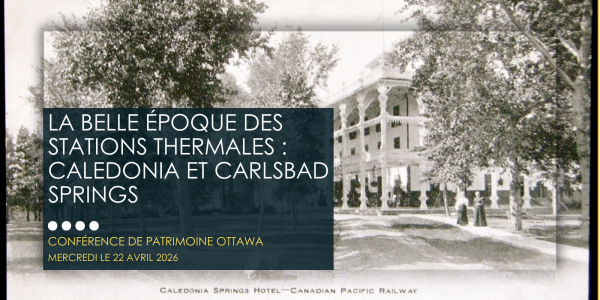
AN IN-PERSON LECTURE | PRESENTED IN FRENCH
Peter D. Clark - Orléans Centre, Room 340, 255 Centrum Blvd., Ottawa
This lecture will be presented in French.
From 1835 to 1915, Caledonia Springs, located in eastern Ontario, was Canada's largest spa resort. Thousands of spa guests from Canada and the United States flocked there to enjoy the healing properties of its mineral springs, its hotels—including the prestigious Grand Hotel—and its many leisure and sporting activities. Carlsbad Springs, closer to Ottawa, targeted the same clientele but never achieved the popularity of Caledonia Springs.
Today, Caledonia Springs is a ghost town, as is the former spa site of Carlsbad Springs. This lecture invites you to discover the factors that contributed to the rise of these two spa towns in the 19th century and their decline in the early 20th century. The speaker will also present his remarkable collection of documents, photographs, and artifacts.
A question and answer period will follow the lecture.
Michel Prévost, D.U., president of the Société d’histoire de l’Outaouais, was chief archivist at the University of Ottawa for 30 years and has been the President of the Société d’histoire de l’Outaouais since 1997. Passionate about thermalism for 45 years, he has published two books and several articles on these two spas and has given numerous lectures on these fascinating places that no longer exist. He has received some 40 awards, including the City of Ottawa Heritage Award and an honorary doctorate from Saint Paul University, in recognition of his outstanding commitment to heritage.
REGISTRATION IS NOW AT CAPACITY.
TOMORROW'S OTTAWA -- SETTING THE PATH TOWARDS TOMORROW'S HERITAGE
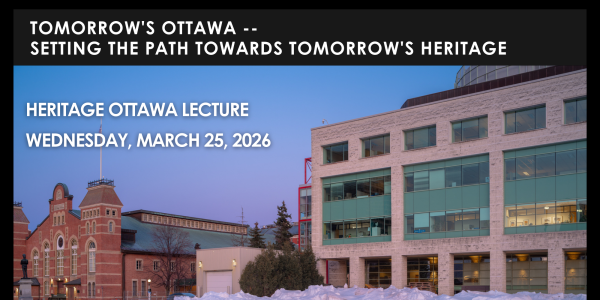
Welcome to the second of two special lectures this month that mark the BICENTENNIAL OF BYTOWN.
Creating better built environments that conserve, restore and honour our past includes creating better places in 2026; better buildings, parks and landscapes that stand the test of time and become our heritage buildings of tomorrow.
How do we create those meaningful experiences through built form that we hope future generations will honor and respect as much as we care about things built over the last 200 years? It starts with better policy, design leadership and engagement to create better places for people.
A question and answer period will follow the lecture.
Toon Dreessen is a graduate of Carleton University, served as President of the OAA (2015 and 2016) and was inducted into the Royal Architectural Institute of Canada College of Fellows and the Order of DaVinci. He leads Architects DCA and is responsible for award-winning and high-profile projects. DCA is a company with roots dating back more than 40 years and is ISO 9001:2015 Certified. He leads the company’s activism and the role of architects in a strategic, visionary, and thoughtful planning. Toon founded, and is Chair, of the Ottawa Architecture Foundation.
HOW BOOZY BYTOWN BECAME CANADA'S CAPITAL
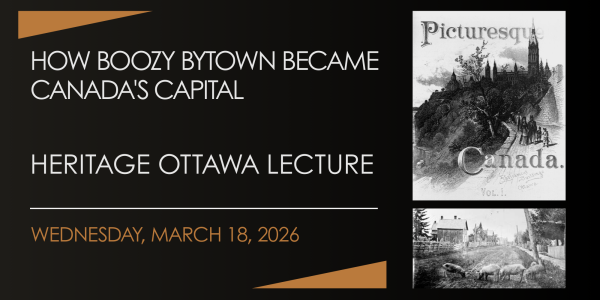
Welcome to the first of two special lectures this month that mark the BICENTENNIAL OF BYTOWN.
Ottawa owes its capital city status to a mob of angry Tories who burned the Canadian Parliament and drove the Governor-General out of Montreal in 1849.
Bytown was never in the early running during the competition to be the seat of government for the United Canadas in the mid-19th century. It was passed over in favour of Kingston (1841) and Montreal (1844) because of its reputation as a lawless frontier town. Bytown lacked police, paved streets, potable water, sewage treatment, or any form of planning to create an attractive capital city.
After the seat of government was driven out of Montreal, the community leaders saw their chance, re-branded Bytown as “Ottawa” and won the competition to become Canada’s capital, much to the surprise and chagrin of the other six cities. This heavily-illustrated lecture will chart Bytown’s transformation from a construction camp to capital city of a new federation that stretched from sea to sea to sea.
A question and answer period will follow the lecture.
David Gordon is Professor in the School of Urban and Regional Planning in Queen’s University’s Department of Geography and Planning. He received his Doctor of Design from Harvard Graduate School of Design. He has taught at a number of universities, including McGill, Toronto, Western Australia, Harvard, and Pennsylvania, where he was a Fulbright Scholar. He is a member of the NCC’s design review committee, Research Chair of the Council for Canadian Urbanism, and a Fellow of the Canadian Institute of Planners, sharing their National Awards four times. David’s books include Town and Crown: An Illustrated History of Canada’s Capital, Planning Twentieth-Century Capital Cities and Planning Canadian Communities. His research examines capital cities, waterfronts and suburbs in Canada, Australia, and the USA. David was born in Ottawa, where his family have lived for almost a century.
DEMOLITION BY NEGLECT
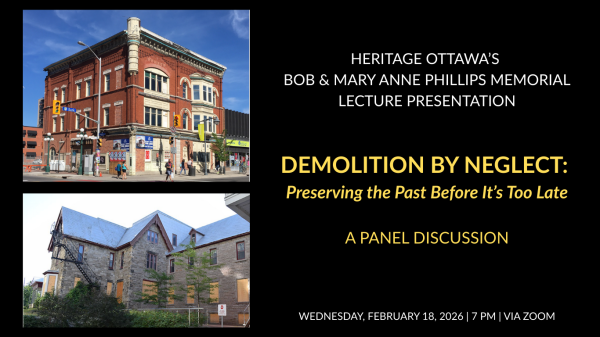
DEMOLITION BY NEGLECT: Preserving the Past Before It's Too Late
On the occasion of our annual Bob and Mary Anne Phillips Memorial Lecture, Heritage Ottawa is pleased to present an important panel presentation on Demolition By Neglect, one of the most vexatious problems of built heritage conservation.
Our heritage buildings are non-renewable resources and important physical reminders of our city’s past. Four panelists will look at various causes of demolition by neglect—from wilful abandonment to costs of rehabilitation—consider possible solutions, and share examples of both positive and negative situations in our city.
Lesley Collins, RPP, MCIP, CAHP is the Program Manager of the Heritage Planning Branch at the City of Ottawa. She is passionate about heritage conservation and very concerned about the occurrence of demolition by neglect where it occurs in our city.
Jack Hanna is Chair of the Centretown Community Association's Heritage Committee. Jack actively champions heritage conservation and helps raise awareness by leading walking tours and advocating for livable, well-designed development in the neighbourhood.
Heather Mitchell is Vice-Chair of the Westboro Community Association's Heritage and Outreach Committee. Heather is motivated by "the systematic destruction" of the area's heritage buildings and her goal of seeing what remains conserved and repurposed.
Linda Hoad is a long-standing member of the board of Heritage Ottawa and its Advocacy Committee. A longtime resident of Hintonburg, Linda has been an active participant on its Zoning Committee. She is also a former member and Chair of Ottawa’s Committee of Adjustment.
KÌWEKÌ POINT REDEVELOPMENT'S INTERPRETATION
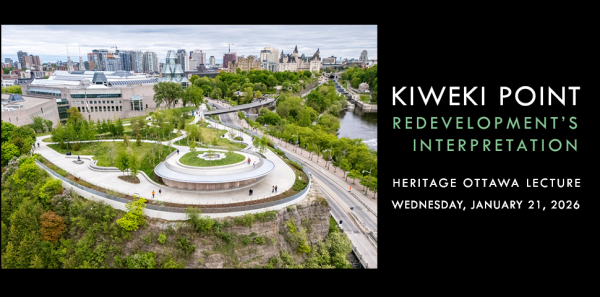
VIA ZOOM | NOW AVAILABLE ON OUR YOUTUBE CHANNEL
The recently completed Kìwekì Point is a signature public realm landscape for the National Capital Commission. The project began with the ambitious goal to reconnect the park with the Ottawa River and transform the pedestrian experience within the National Capital Region. This award-winning Big River Landscape is a powerful public space that honours Algonquin heritage and celebrates the relationship between people, place, and story guided by the Ottawa River.
Garry Meus is a Senior Landscape Architect with the National Capital Commission. Garry’s career as an urban planner, landscape architect, and urban designer has focused on reshaping cities, towns, and communities through inclusive, culturally grounded, and forward-thinking design. He holds a Bachelor in Landscape Architecture from the University of Montréal and a graduate degree in Urban and Regional Planning from the University of New Orleans, with additional studies in urban growth development in Mexico. With experience in private, nonprofit, and public sectors, Garry brings a wealth of insight into creating vibrant, inclusive public spaces that reflect both cultural identity and community needs.
CONCRETE UTOPIAS: WHAT'S (NOT) SO BRUTAL ABOUT BRUTALISM
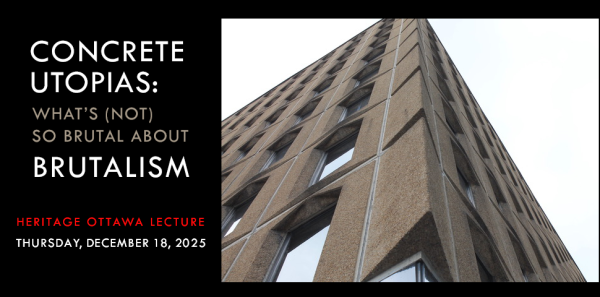
AN IN-PERSON LECTURE This seasonal event will be held at the special venue of the Beechwood National Memorial Centre, Sacred Space Room, 280 Beechwood Avenue, Ottawa
It has been said that brutalist architecture is “unloved but not unlovely.” Beyond the monolithic, opaque, concrete façades are buildings filled with drama, mystery, and strong civic focus. In the postwar building boom and leading up to Canada's Centennial, grand and heroic ideals of civic welfare and cultural identity were translated into a new vision for Ottawa. The strong character of brutalist architecture that followed from these plans and visions embodied renewed hope, stability, and humanity. Yet, today these buildings are commonly (mis)read as imposing and inhuman “eyesores” and little care is given to their heritage value when buildings are renovated or demolished.
In this talk, Dr. Sarah Gelbard highlights Ottawa's brutalist heritage through some of its key buildings including the National Arts Centre and Main Branch of the Ottawa Public Library. She will share how understanding the values and ideals behind these plans and buildings helps us to question what went wrong when they became built realities instead of Utopian visions.
Light refreshments and a chance to mingle will follow the lecture and Q&A session.
Dr. Sarah Gelbard (she/her) is a critical community-based urban planning and architecture scholar. Her research and community work engage with stories of participatory planning, community practices, neighbourhood change, and complex histories of power, exclusion, and urban inequities. She is currently an Adjunct Professor in the Department of Criminology at the University of Ottawa, and a contract instructor at the Azrieli School of Architecture and Urbanism at Carleton University. For well over a decade, Sarah has been sharing her love of Ottawa's brutalist architecture with a popular walking tour as well as several published pieces in Spacing magazine and the Centretown Buzz, and featured in several interviews on the CBC.
Thomas Seaton Scott: Canada's First Chief Architect
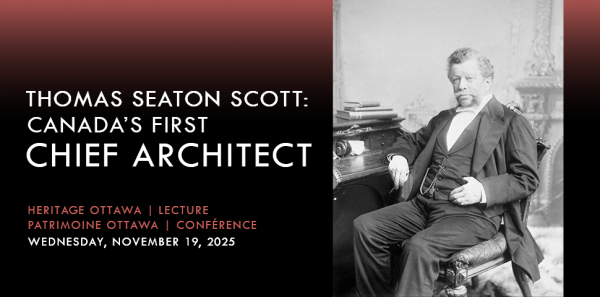
VIA ZOOM | NOW AVAILABLE ON OUR YOUTUBE CHANNEL
The varied career of Thomas Seaton Scott (1826-1895) includes his formative years in Britain, a grand tour of Gothic architecture in Italy and Germany in 1850, the design of small and monumental railway stations for the Grand Trunk Railway and Canadian Pacific, and numerous churches—including St. Bartholomew in Ottawa and erecting Christ Church Cathedral in Montreal. His ten years as Chief Architect at Public Works (1871-1881) saw a brief flourishing of Second Empire style and his personal responsibility for buildings such as Ottawa's Drill Hall, the West Block Mackenzie Tower, completion of the Library of Parliament, the Parliament Hill Summer House, and the first Supreme Court.
David Jeanes has been interested in Thomas Seaton Scott's career for the last 20 years, including original research to correct some earlier negative assessments of Scott and his influence. He has personal experience of Scott's railway, church and government architecture and has studied the architect’s 1850 sketchbooks.
EMERGING SCHOLARS CONNECT! THESE WALLS CAN TALK: STORIES FROM HINTONBURG'S BUILT HERITAGE
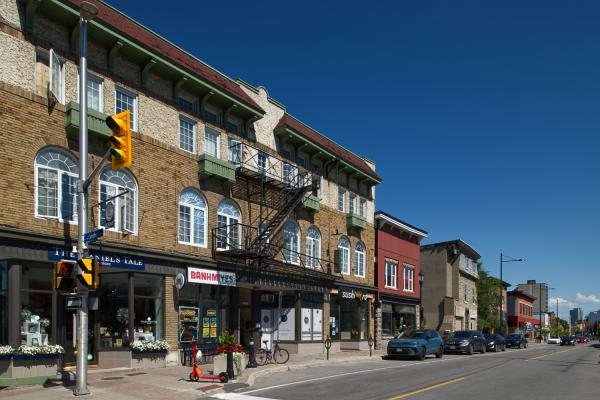
VIA ZOOM | NOW AVAILABLE ON OUR YOUTUBE CHANNEL
We are pleased to feature an Emerging Scholars Connect event with students from Carleton University to highlight how young people are chronicling history and advocating for practices that balance historical conservation with contemporary needs, interests, and values.
Hintonburg today is a lively, diverse and walkable community, with quiet residential neighbourhoods and a vibrant traditional main street with cafés, restaurants, locally owned shops, bookstores, a theatre and a library. But Hintonburg today is just the current fringe of the area’s long story. Hintonburg has always been a place to live and work, but it has also been a centre for manufacturing, filmmaking, and business. Its heritage buildings bear witness to this varied past. If you dig into their history, Hintonburg’s walls can talk.
That digging has been done by a group of Carleton University students of Art & Architectural History, in a seminar offered last winter by the History & Theory of Architecture program. The History and Heritage Committee of the Hintonburg Community Association provided advice and guidance to the students. Their research reveals stories of triumph, toil, renewal, and transformation spanning generations. The stories are told by buildings, about the people who built them and used them. Our students will peel back the layers of Hintonburg’s richly textured past in a series of short virtual presentations.
PHOTO: Iona Mansions, 1131 Wellington Street W, Hintonburg. Credit Peter Coffman
Moderator: Peter Coffman, is an architectural historian and Supervisor of Carleton University’s History & Theory of Architecture program. He is the author of the book Newfoundland Gothic, as well as numerous scholarly articles in Canadian and European periodicals and books. He has degrees from the University of Toronto, Toronto Metropolitan University, York University, and Queen’s University.
Isra Abid is a fourth-year Combined Honours undergraduate student in History and Theory of Architecture and Law. With a passion for the built environment and legal frameworks, she hopes to pursue law school and real estate law.
Tylor Doyle-Chenard is a fourth-Year Art History Major at Carleton University. Through his studies he has developed his appreciation for architectural design and heritage preservation. Tyler has completed two practicums working with with the Audio-Visual Resource Centre (AVRC) at Carleton University.
Zaid Hashim is a graduate student in Urban Planning at the University of Toronto. He has completed his B.A. in History and Theory of Architecture, with minors in Urban Studies and Heritage Conservation. Zaid has a passion for uncovering the layered stories embedded into the built environment.
Teresa Keuleman is a History and Theory of Architecture student at Carleton University. Her research explores Ottawa heritage architecture, including projects with PR-TY Architects, the City of Ottawa, and community associations.
Ana Teoh has a BA in Art History from Carleton University with a minor in Greek and Roman Studies. She is a two-time recipient of the Landen Dominic Burnett Memorial Award and received the Senate Medal upon her graduation in June 2025.
HERITAGE PROTECTION AND CANADA LANDS COMPANY: STEWARDSHIP OF FORMER FEDERAL PROPERTIES
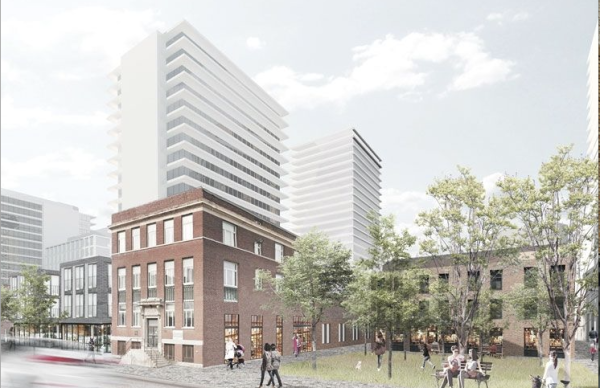
Presented via ZOOM
Canada Lands Company plays an important role in preserving heritage assets on its properties through responsible redevelopment of former federal properties. As a steward of these lands, Canada Lands conducts public engagement that supports the redevelopment of under-utilized lands while including heritage planning to determine key heritage values to be respected, protected and integrated into vibrant new communities.
Through collaboration with Indigenous partners, municipalities, and heritage experts, Canada Lands Company identifies and safeguards historically significant buildings, landscapes, and cultural narratives. Whether restoring iconic structures or commemorating historical events, Canada Lands’ approach balances preservation with innovation, ensuring that heritage remains a living part of Canada’s urban fabric. This presentation will provide an overview of Canada Lands’ commitment to heritage conservation within its current portfolio of projects including projects currently underway in collaboration with the federal government.
Rendering: Booth Street Complex, Canada Lands Company
Mary Jarvis, Senior Director, Real Estate National Capital Region
Katherine Constantine, Senior Director, Real Estate National Capital Region
Spanning Time: The Bridges of Ottawa-Gatineau
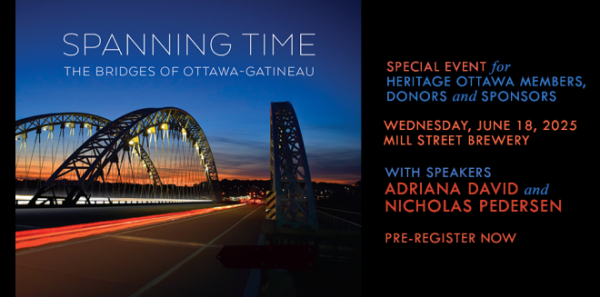
SPECIAL EVENT IN APPRECIATION OF OUR MEMBERS, DONORS, SPONSORS & VOLUNTEERS
Ottawa is a place where three rivers meet: the Ottawa, Gatineau and Rideau. Starting in 2021, and motivated by the possible dismantling of the Alexandra Bridge that opened in 1901, Adriana David spent months researching and recording 44 bridges for an illustrated book that honours the architecture of these spans and stories behind their erection.
Join Adriana who will share what she uncovered about early settlers and the growing communities along the riverbanks, capturing the stories of entrepreneurs, politicians, immigrants, and monarchs, and the First Nations who came before them all, travelling along trade routes that led to the first bridges. Discover how each bridge connects neighbourhoods and the people of Ottawa and Gatineau, and learn about the triumphs and tragedies that lay embedded in the bridges’ stones and steel and how their quiet, constant beauty forms the backdrop to Canada’s Capital.
Adriana David moved to Ottawa in the early 1990s and has spent decades paddling down, running aside, and being amazed by Ottawa’s three great rivers – the Ottawa, Rideau, and Gatineau. In time, she became just as enthralled with the city’s bridges.
Seeing Big - A New Museum for the Outaouais
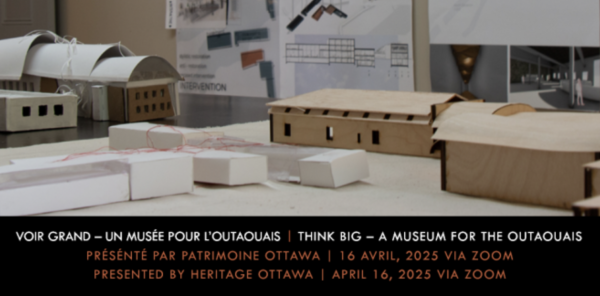
The new Musée régionale de l’Outaouais will be defined by the rich history, heritage and cultural vitality of the region’s broad territory. Creating a new regional museum is a rare opportunity, made even more exciting by housing that museum in a rehabilitated industrial heritage building on the former E.B. Eddy site, in the heart of Gatineau’s core.
This bilingual presentation will provide an overview of the overall project to create a regional museum, and the conservation challenges the project team is facing in adapting the existing building to its proposed new functions.
Jean-Marc Blais is the President of the Musée régionale de l’Outaouais. As a museologist, Jean-Marc has led projects within national museums and for several federal departments that have contributed to the advancement of contemporary museological and conservation practice. He currently leads the Museum in its institutional network mission to promote the study, conservation and sharing of the Outaouais region’s rich and diverse social and cultural history.
Stephen Quick is the Director General of the Musée régionale de l’Outaouais. His vast experience in the Canadian cultural sector includes having been the Director General of the Canadian War Museum, and of the Canadian Aviation and Space Museum, and Vice-President Conservation and Collections for the Ingenium : Canada’s Museums of science and innovation. During his career he also worked at the National Gallery of Canada, the Department of Canadian Heritage, and the publishing industry.
At Home With The Prime Minister: Ottawa Residences of the Prime Ministers Prior to 1952
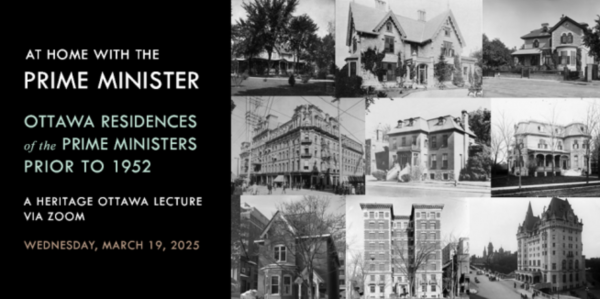
VIA ZOOM | NOW AVAILABLE ON OUR YOUTUBE CHANNEL
Prior to the establishment of 24 Sussex Drive as the official residence, Prime Ministers had to secure their own accommodations in Ottawa. This presentation will look at some of the residences that were occupied by these men both while they were Members of Parliament and Prime Ministers.
The presentation offers a look at their personal lives, rather than their political careers, and will provide a glimpse of the Ottawa of their time.
Hagit Hadaya holds a Master of Canadian Heritage Conservation and a High Honours BA in Architectural History, both from Carleton University. Since the completion of her formal education, she has been researching, writing, and lecturing on a variety of topic dealing with Canadian architectural history.
Hagit has published two books: In Search of Sacred Space: Synagogue Architecture in Ottawa (2013) and At Home With The Prime Minister: Ottawa Residences of the Prime Ministers Prior to 1952 (2017).
She served for two years on the National Capital Commission Advisory Committee on the Official Residences of Canada.
The Ontario Heritage Act Turns 50! The Good, the Bad and the Beautiful
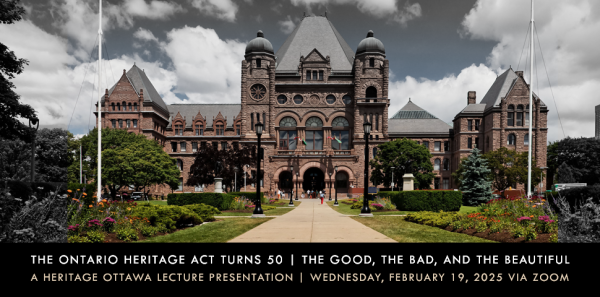
VIA ZOOM | NOW AVAILABLE ON OUR YOUTUBE CHANNEL
On the occasion of our annual Bob & Mary Anne Phillips Memorial Lecture, Heritage Ottawa is pleased to mark the 50th anniversary of the Ontario Heritage Act with a panel presentation on the history, implementation and challenges associated with this seminal piece of legislation.
Fifty years ago, on March 5, 1975, after years of struggle at community and municipal levels, the Ontario Heritage Act was proclaimed, establishing the long sought-after legal process to protect local heritage in the province. The Act gave municipal councils the right to preserve properties and neighbourhoods valued for their cultural heritage significance. It also gave councils the power to delay and ultimately deny approvals for alteration or demolition of designated buildings. And to ensure public participation in the process, the Act provided for the creation of local heritage advisory committees.
But it hasn’t been all smooth sailing. Join our panel presentations to learn about the emergence of a conservation movement in Ottawa, the challenges of implementing the Act, and the examples that show its successes, and its weaknesses.
Photo: Ontario Legislative Building, Queen's Park / Wikimedia Creative Commons License
The Abbot of Kingsmere: Mackenzie King and his Ruins
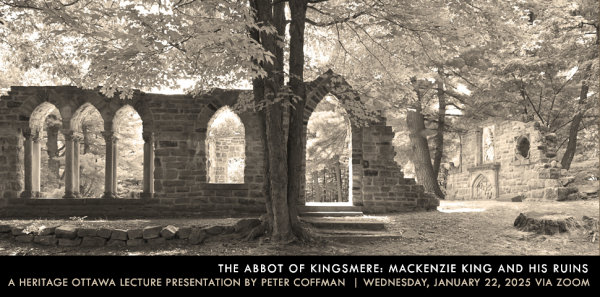
VIA ZOOM | NOW AVAILABLE ON OUR YOUTUBE CHANNEL BY CLICKING HERE.
The architectural ruins that William Lyon Mackenzie King built at his Kingsmere estate defy simple explanation. Today, they are used for everything from picnics to ghost tours to wedding photos. But for King himself, they were hallowed ground. He read poetry among them, buried his beloved dogs there, and even considered having himself buried there. The ruins’ existence seems like an act of extreme eccentricity (to put it politely).
But ruins have their own inner logic and history – not just as individual monuments, but as an idea that has haunted and sparked the imagination for centuries. This presentation will explore the long imaginative tradition in which Mackenzie King’s ruins are situated, how that tradition came to Canada, and the seminal moments when King’s life intersected with it.
Peter Coffman is an architectural historian and Associate Professor in Carleton University’s History & Theory of Architecture program. He specializes in the architecture of the Middle Ages and its revivals. He is the author of the book Newfoundland Gothic, as well as numerous scholarly articles in Canadian and European periodicals and books. He has also written about buildings in several newspapers and magazines, and can usually be counted on to speak up when a controversial architectural issue arises in Ottawa. He has degrees from the University of Toronto, Toronto Metropolitan University, York University, and Queen’s University. He is also an award-winning photographer and in his spare time, he served two terms as president of the Society for the Study of Architecture in Canada and on the Board of Heritage Ottawa.
The Singing Tower on the Hill: A Civic Voice to Commemorate, Communicate & Celebrate
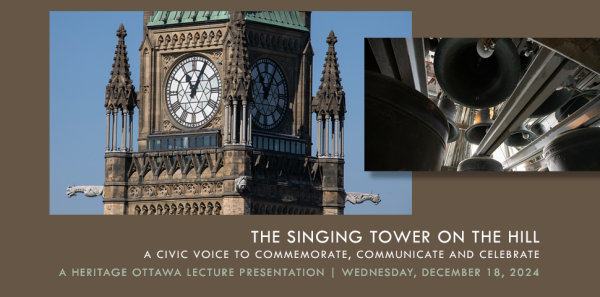
This seasonal event will be held at the special venue of the Beechwood National Memorial Centre, Sacred Space Room, 280 Beechwood Avenue, Ottawa
Like a phoenix, the Peace Tower and its carillon arose from fire and conflict. The Victoria Tower and its single clock bell, destroyed by the Centre Block blaze in 1916, were replaced in 1927 by the Peace Tower and its carillon of 53 bells, installed to keep in remembrance the sacrifice of Canada in the Great War. In the ensuing 97 years, five Dominion Carillonneurs have served to create a uniquely expressive musical voice on Parliament Hill reflecting all aspects of life. The current Dominion Carillonneur, Dr. Andrea McCrady, will chronicle the wide variety of events that the carillon accompanied, from solemn commemorations to festive celebrations.
We invite you to join us for light refreshments and a chance to mingle after the lecture and Q&A session.
Registration is now closed.
Dr. Andrea McCrady was appointed Dominion Carillonneur of the Peace Tower Carillon in 2008. She began playing the carillon in 1971 at Trinity College, Hartford, CT (B.A., 1975). While in Europe on a post-graduate fellowship, she studied at the carillon schools in the Netherlands, Belgium, and France. During medical school at McGill University, Montreal, she was carillonneur at St. Joseph’s Oratory, followed by her hospital residency in Toronto, where she played at the University of Toronto and the Canadian National Exhibition. From 1990-2008, she coordinated the carillon program at the Cathedral of St. John the Evangelist in Spokane, WA, where she also practiced family medicine.
MOSHE SAFDIE — SOCIALLY RESPONSIBLE DESIGN
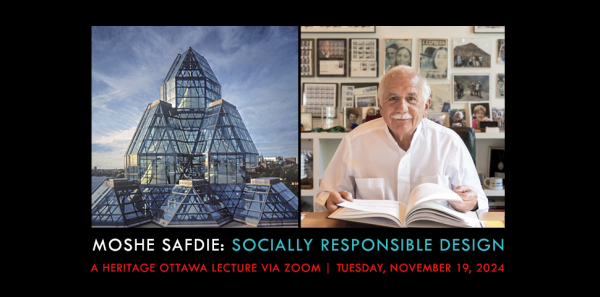
VIA ZOOM | NOW AVAILABLE FOR VIEWING ON OUR YOUTUBE CHANNEL
Moshe Safdie has been practicing architecture for almost 60 years. He has designed headquarters in Boston, Massachusetts, with satellite offices in Jerusalem, Shanghai and Singapore (and occasionally Toronto). His oeuvre encompasses more than 100 completed buildings, including the National Gallery of Canada in Ottawa, communities and master plans on five continents and an even greater number of projects and competition entries. It is impossible to discuss all his projects in one lecture, so this presentation will cover those projects which were either designed for Canada or built in Canada.
Maria Somjen has a B. Env. Des, B. Arch and LL.B. from Dalhousie University. Before her retirement she worked for the government of Canada as a Project Director mostly restoring federal heritage buildings in Ottawa. Her last major project before retirement was the management of the renovation to the Canadian Museum of Nature, which took ten years, and subsequently the planning of the renovation of the Supreme Court of Canada.
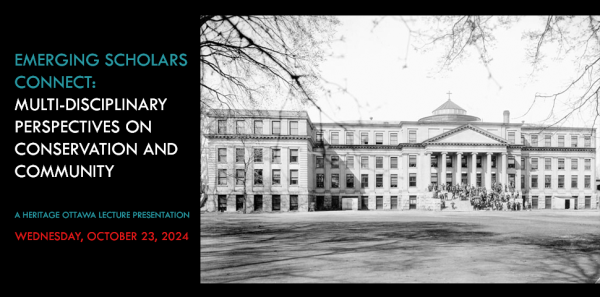
Emerging Scholars Connect: Multi-Disciplinary Perspectives on Conservation and Community
IN PERSON AT UNIVERSITY OF OTTAWA, DESMARAIS HALL, ROOM 1130
FREE LECTURE VIA ZOOM
Young people bring fresh ideas, creativity, and a strong sense of innovation to the preservation of the National Capital’s cultural legacy, ensuring it remains relevant and dynamic for future generations. Interdisciplinary perspectives, whether from History, Public History, Architecture, and other areas of research, can foster a robust connection between Ottawa’s past and its evolving identity. They help bridge the gap between traditional practices and modern values, promote sustainability and inclusivity, and ensure that conservation efforts reflect the diversity of the city’s population.
We are pleased to feature an Emerging Scholars Connect event bringing together students from both the University of Ottawa and Carleton University to highlight new perspectives on heritage and how young people are chronicling history and advocating for policies and practices that balance historical conservation with contemporary needs, interests and values, in many ways.
Presentations and discussions will be in both English and French.
Refreshments will be served after the presentations, with time to mingle! Thank you to TRACE architectures for generously contributing.
Caleb Stevenson is an undergraduate history student at the University of Ottawa with a bachelor's degree in political science. He is particularly interested in late 19th to mid 20th century history, as well as in shifting perceptions of gender and sexuality over time. He is also passionate about the history of Ottawa and enjoys the opportunity to educate the public while working as a tour guide.
Ben Merritt is a graduate student currently pursuing his Master of Architecture at Carleton University. He has worked at TRACE architectures since 2023 and has been involved with various projects within the office. Evolving from his work experience and education, Ben has developed an interest in the processes related to architectural heritage and conservation. Ben’s general interest in the subject is to better understand the technical challenges related to heritage buildings, and how best to address them.
Lilly Zegerius was born in raised in Guelph Ontario and is 21 years old. She is in her third year of study at Carleton University in Architecture Conservation and Sustainability. Her studies focus on adaptive reuse, restoration, and rehabilitation of heritage properties in the context of architecture. She is currently employed by the NCC, where the exposure to the professional side of architecture complements her lessons in studio.
Sophie Soulières is a fourth-year history and political science major at the University of Ottawa. In the past year, she has spent a semester studying at the University of Leiden in the Netherlands and has worked as a Student Guide at the Canadian National Vimy Memorial in France. Sophie is interested in political thought, intellectual history, and uses of history broadly. She is planning on pursuing a Master's degree in library and information science.
Moderator: Patryk Polec has a PhD in Canadian history from the University of Ottawa where he worked as an Assistant Professor. He is the author of two academic books and numerous peer-reviewed journal articles, book chapters, and other contributions related to Canadian military and policing history, armed conflicts, Canadian immigration history, and human rights studies. He currently works at the federal Department of Canadian Heritage, where he is responsible for developing and vetting historical content for high-profile public exhibits, monuments, publications, and commemorative projects of national significance.
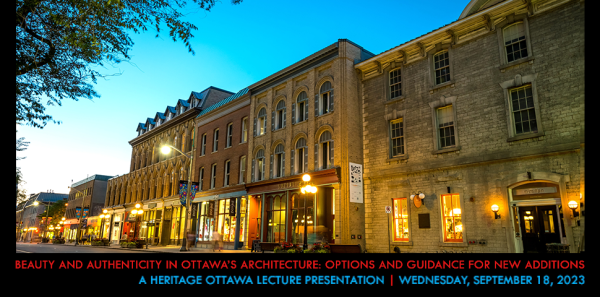
Beauty and Authenticity in Ottawa’s Architecture: Options and Guidance for New Additions
In person at the Carleton Dominion-Chalmers Centre, Woodside Hall, 355 Cooper Street and Via ZOOM | | Now Available on our YouTube channel.
How should a new heritage district building or building addition look? Must it “be of its time?” Should it be faithful to the area’s existing traditional buildings? Who should decide?
Classic Planning Institute Founder Dr. Nir Buras will explain how Modernism became the dominant style in the 20th century. He will ask, “What is the place of Modernist expression?” and “Why can’t we have façades and roofs anymore?” He will share worldwide examples of new traditional architecture, and give us food for thought regarding ornament, indigenous architecture, and beauty. Dr. Buras will discuss how traditional architecture helps express Canada’s genuine architectural roots as well as Canada’s future.
Alain Miguelez – Vice-President, Capital Planning and Chief Planner at the NCC will review the Canadian context and explore choices that could be incorporated in the new NCC Core Area Plan. Alain will bring up the interpretation of Standards and Guidelines for the Conservation of Historic Places in Canada and refer to the “Philadelphia Approach” in making deliberate decisions on choice of architectural expression in response to urban context, and how this approach might fit in the NCC framework for the new Core Area Sector Plan.
Join us for this exciting and thought provoking presentation!
To register for this FREE in-person event at the Carleton Dominion-Chalmers Centre, EMAIL info@heritageottawa.org.
Dr. Nir Buras is a leading new traditional architect and urbanist, founder of the Classic Planning Institute, and author of The Art of Classic Planning. Dr. Buras designs towns, cities and buildings, he runs experiments, holds workshops, writes, and speaks about some of the most interesting developments in the world of architecture and planning—and where we might find ourselves in the future. His work helps communities with their long-term planning, and architects who are inventing new local styles. He teaches Classic Planning Institute Fellows architectural literacy and classic planning basics and researches the neuroscience of the built environment with his scientific colleagues.
Alain Miguelez is the Vice-President of Capital Planning and Chief Planner of the National Capital Commission. He oversees four Divisions: Long Range Planning; Transportation Planning; Federal Approvals, Heritage and Archaeology; and Sustainable Development and Environmental Services functions. Prior to the NCC, he worked almost 20 years with the City of Ottawa in several capacities within the Planning Department, most recently as Manager of Planning Policy where he led his team to the preparation of the City’s 2021 Official Plan. He is the author of two books: Transforming Ottawa: Canada’s Capital in the Eyes of Jacques Gréber (2015) and A Theatre Near You: 150 Years of Going to the Show in Ottawa-Gatineau (2004).
An Evening with the Right Honourable Adrienne Clarkson
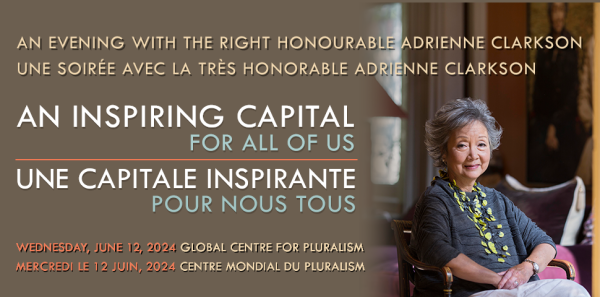
An Inspiring Capital for All of Us: An Evening with the Right Honourable Adrienne Clarkson
Global Centre for Pluralism, 330 Sussex Drive
Heritage Ottawa is pleased to partner with the National Capital Commission (NCC) and the Global Centre for Pluralism for an evening with the Right Honourable Adrienne Clarkson who will present From Sussex Street to Sussex Drive: A refugee’s journey to Rideau Hall. After the presentation, she will be joined by NCC CEO Tobi Nussbaum and Heritage Ottawa President Katherine Spencer-Ross for a fireside chat on making a great capital city.
From Sussex Street to Sussex Drive: A refugee’s journey to Rideau Hall
When the Poy family arrived in Ottawa in August 1942, they were able to find lodgings at 277 Sussex which was then a duplex. Those early years were difficult but happy. Difficult because there was the adjustment to a new country, a new society and a very small white town full of white bread and white snow. However, people were kind, the Poy family was somewhat a novelty and people were sympathetic that Hong Kong fell to the Japanese.
“Taking the streetcar from outside our front door to Rockcliffe Park with a picnic basket and a rug, but looking forward to the hotdogs that were sold in the lovely stone building which was in the park, is an everlasting memory. We went to the park almost every weekend on Sundays, and in the winter we began tobogganing down the hills there. My public and high school years were happily spent at Kent and Elgin Street Public Schools and Lisgar Collegiate where my goals and ideals and education were set for life. Ottawa has a great deal of meaning for me because it was where I was formed as a young person and where early influences, like my English teacher Mr. Mann in high school and my public school teacher Ms. McRae at Elgin Street Public, helped to form me, my values and my ideals.
I guess I’ve seen the city grow astonishingly and I have many memories of it as it was during the war with temporary buildings on the lawns in front of the Supreme Court and the Canal really just being a muddy ditch alongside the railway that led to the great Union Station. I have seen Ottawa transformed but I still remember it as that small town I grew up in.”
The Honourable Adrienne Clarkson
NOTE: Due to space limitations, all registrant names will be checked at the door.
This event has now reached its capacity.The Right Honourable Adrienne Clarkson arrived in Canada from Hong Kong with her family in 1942 and made the astonishing journey from penniless child refugee to accomplished broadcaster, journalist, and distinguished public servant in a multi-faceted lifetime.
As Canada’s 26th Governor General from 1999-2005, Adrienne Clarkson is universally acknowledged to have transformed the office, leaving an indelible mark on Canada’s history. When she left Rideau Hall, she co-founded the Institute for Canadian Citizenship which helps new citizens to feel involved and included in Canadian life. The ICC offers a one-of-a-kind program, Canoo, an app that gives newcomers free VIP access to over 1,400 of Canada’s best cultural and outdoor experiences.
Bestselling author of the 2014 CBC Massey Lectures Belonging: The Paradox of Citizenship, Adrienne Clarkson also wrote Room for All of Us: Surprising Stories of Loss and Transformation; her autobiography Heart Matters: A Memoir; and Extraordinary Canadians: Norman Bethune, a biography of Dr. Norman Bethune.
A Privy Councillor and a Companion of the Order of Canada, Adrienne Clarkson is the National Institute on Ageing’s Honorary Chair for its Advisory Board.