Lecture Series
Heritage Ottawa has lined up an enticing program for our 2026-2027 Free Lecture Series!
We ask that you PRE-REGISTER in advance of each free lecture.
The lectures begin at 7 pm and are presented via ZOOM, unless otherwise indicated, and last approximately one hour.
Note: Several of our lectures are available for viewing on Heritage Ottawa's YouTube channel .
Upcoming Lectures
Past Lectures
How a Cohesive Architecture Policy Can Create a Better Built Environment
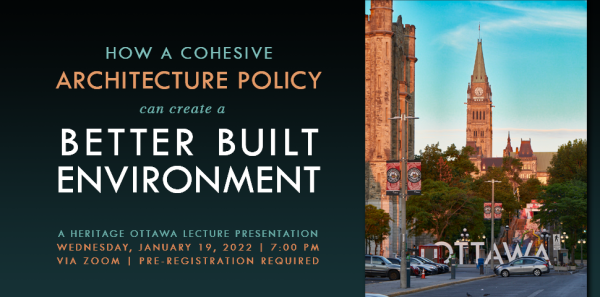
An architecture policy for Canada will create a framework against which other policies can be tested, bringing together disparate approaches to create the built environment we aspire to.
“It’s not so much just about ugly buildings, but really about what the built environment says about us as a people,” Toon Dreessen told CBC Radio’s Ottawa Morning.
Join Toon who makes a compelling case for having consistent policies across different geographies and levels of government that will help make the case for heritage preservation, and help establish a model for improved appreciation of our cultural heritage.
The Lecture will be presented via ZOOM.
Toon Dreessen is a graduate of Carleton University and recipient of the Alpha Rho Chi medal. Toon is a member of the American Institute of Architects and was inducted into the RAIC College of Fellows in 2016 and the Order of DaVinci in 2020. He leads Architects DCA, the company and is responsible for award winning projects in infill development, laboratory, research, industrial and high profile projects. Architects DCA is a company with roots dating back more than 40 years and is ISO 9001:2015 Certified.
Cundell Stables: The Last Stable in Lowertown
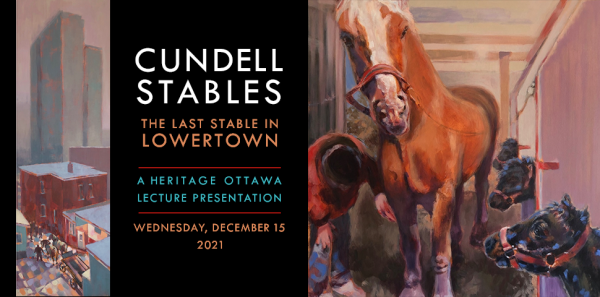
Thanks Cundell Stables has been operating as a family business in Lowertown since the 1870s. It remains the last vestige of Ottawa’s equine history and is teetering on the verge of extinction.
The Lecture will be presented via ZOOM.
Artist Karen Bailey and writer Marc Aubin joined forces to combine both fine art and local history in their book, The Last Stable in Lowertown: Cundell Stables, Ottawa. Karen will present an illustrated lecture that pays homage to the Cundell family using her art that documents the present day working life at the stables in paintings, and Marc’s research and writing that places the Cundell family history within the context of Lowertown.
The Cundell Stables project was supported by Heritage Ottawa’s Gordon Cullingham Research and Publication Fund.
An exhibit of Karen Bailey's paintings of the Cundell Stables operation took place in February at the Ottawa School of Art. The Last Stable in Lowertown? La dernière écurie de la Basse-Ville is available for purchase at the Ottawa School of Art on George Street and Books on Beechwood.
Karen Bailey is an artist who’s career spans four decades. A visual storyteller, themes of service and community inform her work. In 2007 she travelled to Afghanistan as an appointed war artist to document Canadian military medical personnel and published Triage: An Artist in Kandahar. Her official portrait of the Right Honourable Michaëlle Jean, 27th Governor General of Canada, was unveiled in 2012.
Opportunities and challenges in protecting our Cultural Heritage: ICOMOS´ international collaboration trajectory
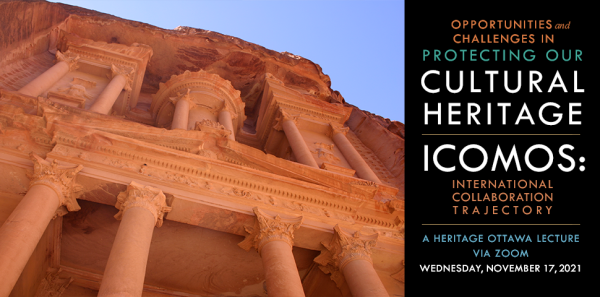
The International Council of Monuments and Sites (ICOMOS), an advisory body to UNESCO’s World Heritage Committee, has a network of 10,000+ professionals worldwide. Established over 50 years ago, ICOMOS’ trajectory has produced a philosophical and doctrinal framework for protecting heritage on an international level. The resulting achievements have offered great opportunities, but also many challenges. Conflict, climate disasters, development pressures, and now the pandemic are threatening the overall integrity of cultural heritage in ways never seen before. ICOMOS is striving to offer technical expertise independently that is in keeping with the ethical rules that could mitigate these threats.
Mario Santana-Quintero is a professor at the Department of Civil and Environmental Engineering at Carleton University. He is also the Director of the NSERC Create program Heritage Engineering and faculty member of the Carleton Immersive Media Studio Lab (CIMS). Besides his academic work in Canada, he is a guest professor at the Raymond Lemaire International Centre for Conservation (University of Leuven). Along with his academic activities, he serves as Secretary General of the International Council of Monuments and Sites (ICOMOS), and is a past president of the ICOMOS Scientific Committee on Heritage Documentation (CIPA). Mario is a Getty Conservation Institute scholar and has collaborated in several international projects in the field of heritage documentation for The Getty, UNESCO, Bahrain Authority for Culture and Antiquities, ICCROM, World Monuments Fund, UNDP, Welfare Association, and the Department of Culture and Tourism of Abu Dhabi.
Emerging Scholars Present: Learning from Ottawa School Heritage Stories
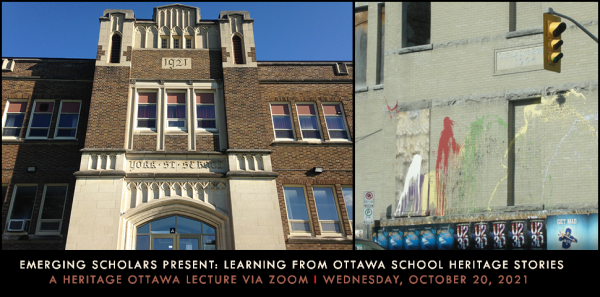
From communities reacting to health and safety measures, to findings about unmarked graves on former Indigenous Residential School properties, schools have been in the news across Canada.
This Emerging Scholars lecture presents the impressive project results of a winter 2020 graduate seminar on heritage conservation at Carleton University. Ten students collaborated on case studies and thematic essays to examine conservation issues, successes, and losses of Ottawa’s school heritage. With help from a Heritage Ottawa Gordon Cullingham Research Grant, professor Susan Ross and student Micah Norris further developed and transformed the results into the Ottawa School Heritage website.
The class project looked as much at pressures for change, such as growth, urban renewal and closures, as at achievements, including cases of ongoing use or adaptation, or site improvements to meet new goals.
Susan Ross is Associate Professor in the School of Indigenous and Canadian Studies at Carleton University, and cross-appointed to the Azrieli School of Architecture and Urbanism. Susan has worked as an architect in Montreal and Berlin and is a former senior conservation architect in the federal government in Gatineau.
At the time of the project, Micah Norris was working towards his MA in Canadian Studies, Robin Hoytema towards her M.Arch and Nivethini Jekku Einkaran and Kamal Raftani were each completing a Graduate Diploma in Architectural Conservation. They have now all graduated.
The Alexandra Bridge: Its Construction, Its Significance, Its Future
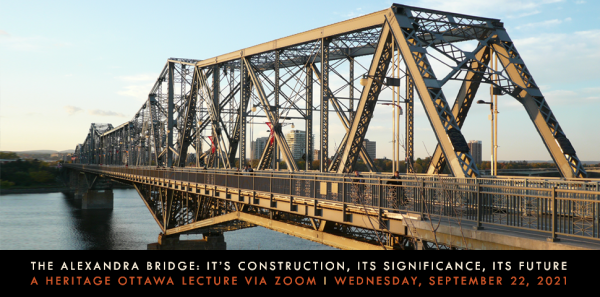
A timely lecture that you won't want to miss! Federal plans are underway to demolish this iconic interprovincial link. Although the bridge was designated a national historic civil engineering site in 1995, the recognition affords no legal protection.
This two-part lecture begins with David Jeanes and the history of the Alexandra Bridge: the progress of its construction from 1898 to 1901, the rationale behind the selection of the cantilevered design to meet the unique requirements of this crossing of the Ottawa River, its ranking among other cantilevered bridges in Canada and elsewhere, and its conversion from a railway and streetcar bridge to a road, cycling and pedestrian crossing after 1966.
In the second part of the lecture John Zvonar looks at the role bridges play in our collective consciousness — the Ironbridge, the Firth of Forth, the Brooklyn Bridge, the Golden Gate — and presents case studies of relevant community-driven campaigns to preserve historic bridges: the Chapel Bridge in Switzerland, the Bennerley Viaduct in central England, and within Canada, the rehabilitation of the wooden Kinsol Trestle on Vancouver Island, and the repair and reconstruction of the Kettle Valley Steam Railway in the Okanagan Valley. Closer to home, the story of the Bank Street Bridge, which was fully restored and not replaced with a contemporary structure, will be examined.
David Jeanes is a former president of Heritage Ottawa and Transport Action Canada, who he has a strong interest in railway history and railway station architecture and belongs to numerous railway-related societies. In 2001, he organized a celebration of the centenary of the first train to cross the Alexandra Bridge and he has written and lectured about the bridge often since then.
John Zvonar recently retired from the federal government’s centre of expertise in Heritage Conservation, employing a values- and principles-based conservation approach in protecting nationally-significant cultural landscapes notably for Parks Canada and within the Parliamentary and Judicial Precincts. He also continues his active involvement with the Friends of Maplelawn Garden, the Alliance for Historic Landscape Preservation, and serves as the Canadian voting member with the ICOMOS-IFLA International Scientific Committee for Cultural Landscapes. John was elected to the Canadian Society of Landscape Architects’ College of Fellows in 2014. Since his arrival in Ottawa from Thunder Bay/Winnipeg, John has been infatuated with the Alexandra Bridge.
Bauhaus and the White City of Tel Aviv
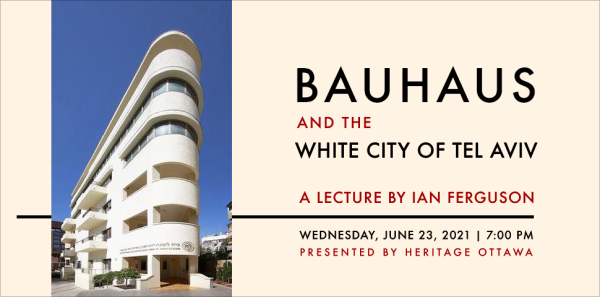
This special lecture takes us outside Canada to look at how the Bauhaus — founded over 100 years ago — spread internationally and in particular, how it took root in Tel Aviv under the British Mandate in Palestine.
The White City area of Tel Aviv, constructed mainly in the 1920s and 1930s, is now a UNESCO World Heritage Site, designated for its “outstanding architectural ensemble of the Modern Movement in a new cultural context.”
The presentation will introduce the pioneering architects who brought modernist ideals from Europe and adapted them to climate, topography and social structures, helping to ensure the style’s success while reflecting modernist aspirations of a new architecture for a future nation.
The use of local materials, the creative use of balconies, and adherence to the innovative urban planning principles of Sir Patrick Geddes, one of the foremost theorists in the early modern period, all contributed to a sustainable outcome which has permanently shaped Tel Aviv’s urban life and streetscapes.
Ian C. Ferguson is an independent scholar and curator who earned an M.A. in Art History at Carleton University in 2014. He had previously served in the Canadian diplomatic service. After visiting Tel Aviv in 2016, he was inspired to research its architectural history. Ian has lectured on this topic in co-sponsorship with the World Congress of Art Deco Societies, the Art Deco Society of Montreal, the Toronto Architectural Conservancy and the Toronto Society of Architects. He has published articles in the Journal of Canadian Art History and the National Gallery of Canada’s online magazine. Ian also serves on the Board of Heritage Ottawa and as a docent at the National Gallery of Canada.
The Changing Architectural Landscape of Vanier: Possible Future Avenues (IN FRENCH)
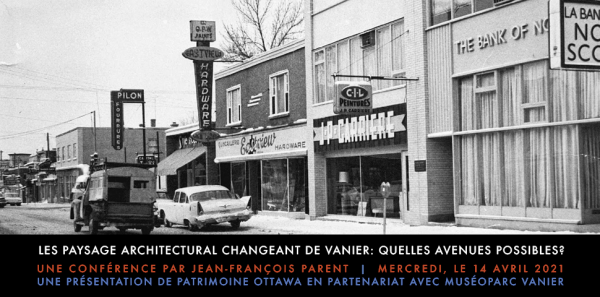
CLIQUEZ ICI pour la version française.
Presented in partnership with Muséoparc Vanier.
This French-language presentation will explore issues related to re-development of the neighbourhood of Vanier, and provide a better understanding of the spirit of the times from which these issues emanated. The presentation will examine the roots of the neighbourhood and the announced projects in coming years, and provide insights as to how the current transformations will influence the neighbourhood over the next decades.
This lecture will be presented in French with questions being answered in both French and English.
Jean-François Parent, M.A. Geography, University of Ottawa, is a proud Franco-Ontarian and a former researcher at the Vanier Museopark. He currently works for the Ontario Cooperation Council.
Canadian Gothic
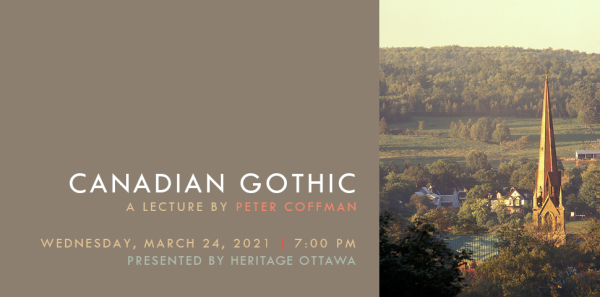
How did an architectural style synonymous with medieval Europe become the style of choice in nineteenth- and early twentieth-century Canada?
This illustrated talk will take us on a journey that begins in the Middle Ages, dips into the popular horror novels of the eighteenth century, crashes into the windswept, rocky coasts of Newfoundland and ends up in downtown Ottawa. The thread that links all these is an idea of “Gothic” that, while inspired by the Middle Ages, is constantly evolving, re-imagined and re-built.
Peter Coffman is an architectural historian specializing in medieval architecture and its revivals. He is the author of the book Newfoundland Gothic, as well as numerous scholarly articles in Canadian and European periodicals and books. He has a B.A. from the University of Toronto, a B.A.A. from Ryerson University, an M.A. from York University and a Ph.D. from Queen’s University. He is the Supervisor of Carleton University’s History and Theory of Architecture program, and served two terms as President of the Society for the Study of Architecture in Canada. He is also a Board member of Heritage Ottawa.
Phillips Memorial Lecture: Saving the Rideau Street Convent Chapel
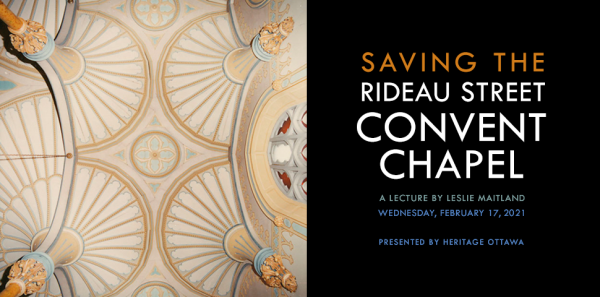
One of the architectural gems of the nation, now a jewel in the crown of the National Gallery of Canada, is the Rideau Street Convent Chapel. A captivating space, its rows of delicate columns support intricately carved and painted fan vaults, the only such set of fan vaults in Canada. Its extraordinary design is the work of its brilliant architect, Georges Bouillon, and due in no small measure to the superb craftsmanship of the woodworkers and painters who executed his unique design.
The origins of this space, how it was saved from demolition, how it came to reside in the National Gallery, and what this saga of near-disaster and survival has to say about heritage protection in this country are the subjects of the presentation.
Who saved this chapel, and why? What does it represent to us today? Why does this kind of destruction of an historic complex like the Rideau Street Convent happen again and in Canada?
Leslie Maitland is an architectural historian who worked for many years for the National Historic Sites Directorate of Parks Canada, where she was involved in the designation of over 70 national historic sites and federally designated structures. Leslie later moved to the private sector, working on planning programs for Ontario Place, the Ontario Science Centre, and other prominent complexes. She is a past president of Heritage Ottawa and a current board member.
Gold, Snakes, and Mother Insurance: Preservation of the 180 Wellington Building Mosaic
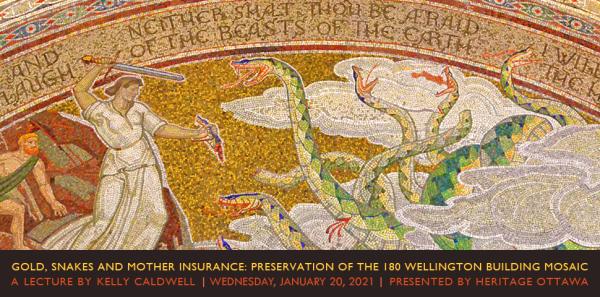
Built in 1927 as the headquarters of the Metropolitan Life Insurance Company, 180 Wellington Building’s most stunning feature is the dramatic mosaic on the vaulted ceiling inside the main entrance. Created by American muralist Barry Faulkner in 1927, the mosaic depicts “The Great Metropolitan Mother” protecting the insurer’s policy-holders. Acquired by the federal government in 1973, the major six-year rehabilitation of the building that began in 2010, included the restoration of the artistic mosaic and its nearly one million coloured tiles of glass.
Kelly Caldwell is a Conservator for CSI Canada and EverGreene Architectural Arts, with a background in architectural and archaeological conservation and preservation. Kelly holds an MSc in Conservation for Archaeology and Museums and an MA in Principles of Conservation from the Institute of Archaeology at the University College London.
Emerging Scholars: Two Talks and a Pub Night
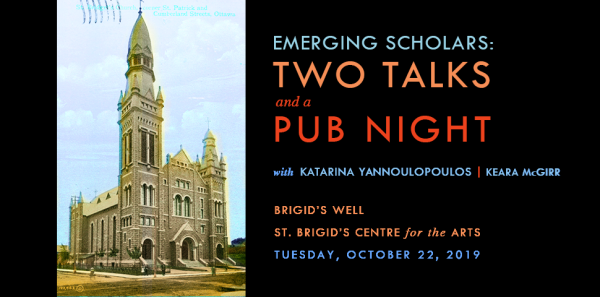
This talk looks at the refurbishment, renovation and historical preservation of the ground floor of Algonquin College’s “B” Building. Built in the 1960s, “B” Building boasts defining, historically significant Brutalist characteristics which play an integral role in the proposed campus rejuvenation. Complimenting the Brutalist technique with equally introspective design can result in a building with a past, present, and future.
Speakeasy Gallery: Interactive Design to Enhance Young Adult’s Art Gallery Experience
With young adults’ social media interest in mind, The Speakeasy Gallery demonstrates an innovative, technological approach to gallery design. Located in Montreal, QC, the project incorporates color theory, natural elements, and imagination within a re-purposed 19th century textile factory.
Katarina Yannoulopoulos is a recent Algonquin College Bachelor of Interior Design graduate working at Perkins+Will as a Junior Designer. Prior to Algonquin, she attended Carleton University’s History and Theory of Architecture Program.
Keara McGirr recently graduated from the Bachelor of Interior Design program at Algonquin College.
Modernism for the Masses
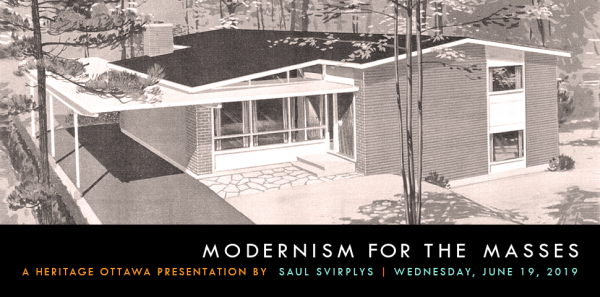
During the mid-20th century, Ottawa homebuilders introduced modern design to tract housing.
Some embraced the modern ethos wholeheartedly, while others sprinkled touches of it throughout their developments. These houses made modern architecture accessible and in many ways, made it a part of mainstream culture in the city.
Saul Svirplys is an architectural historian and suburban geographer specializing in Canadian and American housing design. He has a personal collection of well over 20,000 historic residential floor plans and new homebuilding ephemera. Continuing his passion for housing, Saul also works as a Broker of Record in the real estate industry and blogs at modernrealtor.blogspot.com
Meet the Developers: Apartment Building Construction in Ottawa, 1900 to the Present
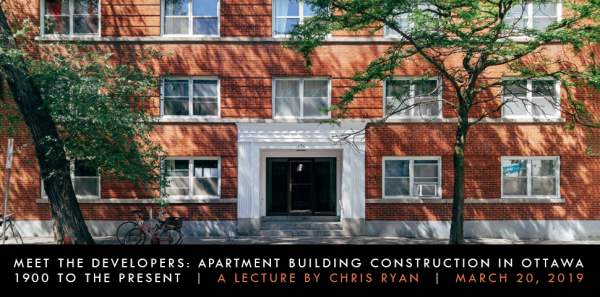
Although developers of Ottawa’s apartment buildings are less well-known than the architects who designed them—after all, it is a building’s appearance that endures—it was these local entrepreneurs who chose the architects, hired the contractors and took the financial risks.
This lecture looks at some of the most important apartment building developers in Ottawa and how they shaped (and reshaped) the residential landscape over the decades. Find out who they were, and what they accomplished, from the construction of the city’s first apartments at the turn of the 20th century through to the present.
Christopher Ryan, a local historian based in Centretown, is a contributor to the recently published book, From Walk-Up to High-Rise: Ottawa’s Historic Apartment Buildings and author of his website, The Margins of History.
Modern History: Preserving Canada’s legacy of modernism
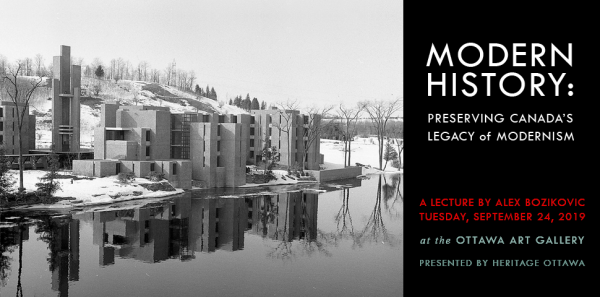
The architecture of the Modernist movement once spoke of the future. Now the buildings of the 1950s, ‘60s and ‘70s are past middle age. They need work — and a critical look. This problem of modern preservation is acutely important for Canada, which built many of its public buildings, schools and cultural facilities during the Modern period. How do we reconsider these places today? And what tools can we use to adapt them for the future?
Alex Bozikovic is The Globe and Mail's architecture critic; his work appears regularly in the Arts section and in the news pages. He is co-author of Toronto Architecture: A City Guide (McClelland and Stewart, 2017). He is the recipient of a National Magazine Award as well as the 2019 President’s Award for Media in Architecture from the Royal Architectural Institute of Canada. He has also written for numerous design publications.
CLICK HERE for a reading list associated with this lecture.
The Firestone Collection of Canadian Art: An Evening with Brenda Firestone
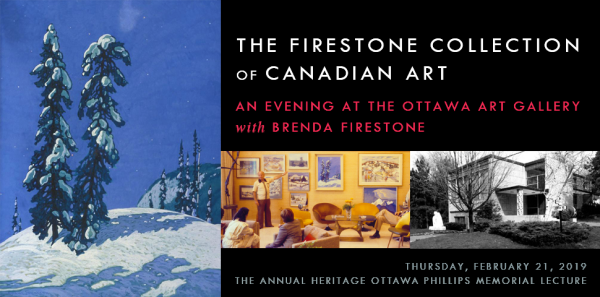
O.J. and Isobel Firestone were passionate collectors of Canadian art. In the early 1950s, they embarked upon a collection that would grow to more than 1,600 works by noted Canadian artists, spanning the modern era from 1890 to 1985.
To complement their growing art collection, in 1960 Dr. Firestone worked with architects Sam Gitterman and George Bemi to design a landmark modernist home for his family in Ottawa’s Rockcliffe Park. Both the home and collection were generously donated by the Firestones to the Ontario Heritage Trust, (then the Ontario Heritge Foundation) which in 1992 transferred ownership to the City of Ottawa.
Today, the Firestone Collection of Canadian Art is permanently housed at the new Ottawa Art Gallery (OAG). While the family home no longer stands, its original modernist staircase is installed in the OAG where it leads, poetically, to the Firestone Gallery.
Join us for an evening with Brenda Firestone as she shares stories about the history of her family’s home and significant collection of Canadian artworks.
The talk will conclude with an opportunity to visit the Firestone Gallery and converse with Ms. Firestone.
The Jackson café will be open for drinks and light refreshments.
Brenda Firestone is a lifelong supporter and advocate of the arts. She is currently the family spokesperson for the Firestone Collection of Canadian Art.
CLICK HERE for a reading list prepared with the assistance of the Ottawa Public Library to accompany this lecture.
The annual Phillips Memorial Lecture honours the memory of Bob and Mary Anne Phillips, co-founders of Heritage Ottawa which began in 1967 as the Heritage Committee of "A Capital for Canadians".
Tempting Values for Early Shoppers: The Birth of Ottawa’s Department Stores
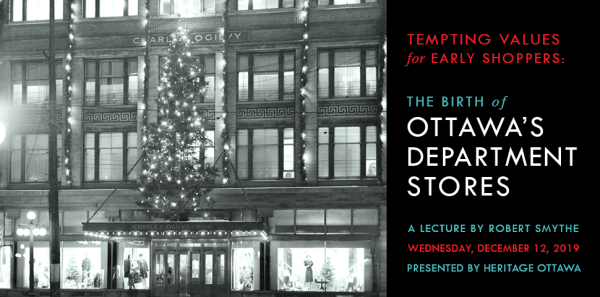
The department store was the product of an increasingly leisured middle class, a new consumer economy, and architectural innovations like plate glass windows, electric lights and passenger elevators. In comparison to the great metropolitan centres, Ottawa’s fondly remembered versions of these emporia of wonders were smaller in scale, but equally ambitious and great objects of civic pride.
To warm your holiday gift buying experience, visit stores like A.E. Rea and Co., R.J. Devlin Co., Bryson Graham Ltd., Murphy-Gamble Co., Charles Ogilvy Ltd., and A.J. Freiman’s.
This seasonal event will be held at the special venue of Dominion-Chalmers United Church.
We invite you to join us for refreshments. The book will be available for purchase at the lecture.
Robert Smythe is a contributor to the recently published book, From Walk-Up to High-Rise: Ottawa’s Historic Apartment Buildings and is the author of the architectural history blog Urbsite.
CLICK HERE for a reading list prepared with the assistance of the Ottawa Public Library to accompany this lecture.
Preserving Canada’s Heritage: The Foundation for Tomorrow
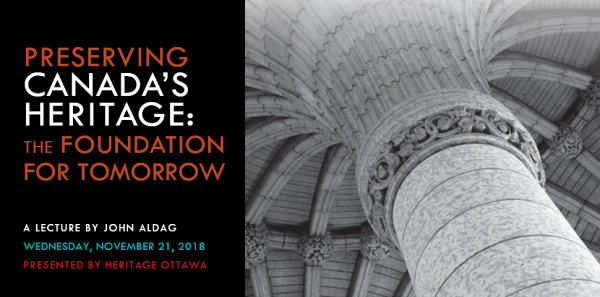
The federal government, proud steward of many national historic sites and other designated heritage properties, has an important role to play in the preservation of Canada’s built heritage and historic places. MP John Aldag will discuss initiatives being considered and undertaken at the federal level, including through Parliament, and their implications for our heritage.
PHOTO: Cover of Preserving Canada's Heritage: The Foundation of Tomorrow
John Aldag is the Member of Parliament for Cloverdale-Langley City. He chairs the Standing Committee on Environment and Sustainable Development. As a parliamentarian, John Aldag introduced Bill C-374, to include much-needed Indigenous representation on the Historic Sites and Monuments Board of Canada. Previously, John spent 31 years managing parks and historic sites with Parks Canada.
CLICK HERE for a reading list prepared with the assistance of the Ottawa Public Library to accompany this lecture.
Carved in stone: The Art of Architectural Stone Carving
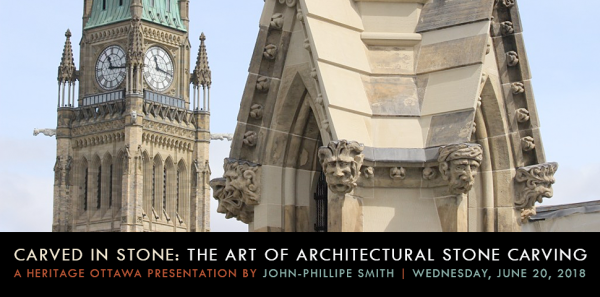
From the European guilds of the Gothic era to modern day digitally assisted techniques, John-Philippe Smith will discuss the history of stone carving as well as tales from his journey working as a sculptor in Canada and in France.
John-Philippe Smith is an architectural stone carver and co-founder of Smith & Barber - Sculpture Atelier Inc. who has worked on the Parliament buildings since 2001.
We invite you to join us for refreshments beginning at 6:30 pm.
OMB Reform: Getting Heritage Planning Right
We have all seen the problem. City Council-approved Official Plans, Neighbourhood Plans and Heritage Conservation District Guidelines – developed to safeguard communities’ criteria for density and building heights – are successfully challenged by property developers at the Ontario Municipal Board. The four-storey height limit on a neighbourhood main street is rezoned to allow for a 10-storey building, or a large lot that contributes to the heritage character of a HCD is approved for subdivision.
To say that the workings of the OMB have been controversial is an understatement. Now it is set for revision. Will Ontario finally get heritage planning right?
Join Attorney General Yasir Naqvi, former OMB adjudicator and advocate Marc Denhez, and community activist Jay Baltz for an evening of discussion on new directions for the Ontario Municipal Board and its replacement Tribunal.
The Honourable Yasir Naqvi is the Attorney General of Ontario, Ottawa Centre MPP, Commissioner of the Board of Internal Economy and Government House Leader.
Marc Denhez is an Ottawa lawyer, mediator and author on heritage policy who served on the Ontario Municipal Board and on the Conservation Review Board.
Jay Baltz PhD is a long-time Ottawa heritage advocate who has served on the board of Heritage Ottawa, and is a former Chair of the Ottawa Built Heritage Advisory Committee.
And after: The consequences of World War 1
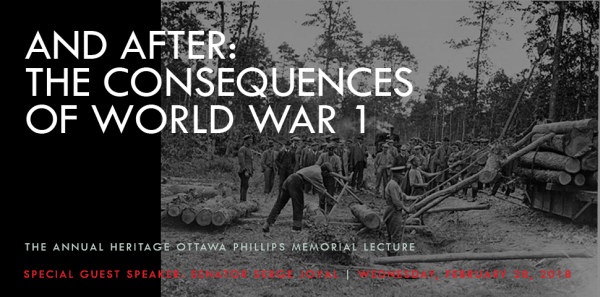
AND AFTER: The Consequences of World War 1
In commemoration of the centenary of the First World War, joint Canada-France symposiums were held in the National Assembly in Paris last May and the Senate in Ottawa last November. The symposiums gave participants the opportunity to reassess the defining impact the War of 1914-1918 had on Canada, its Parliament, its institutions, its people and its economy. The outcome saw the publication of a book, Le Canada et la France dans la Grande Guerre, 1914-1918, co-edited by Senator Serge Joyal and military historian Serge Bernier.
Senator Serge Joyal is the author/editor of numerous articles and books on Parliamentary and constitutional law as well as Canadian history. He has actively campaigned for the protection of cultural heritage and for the improvement of urban life. Senator Joyal is an Honourary Trustee of the Canadian Centre for Architecture (CCA), past-president of the Société des musées québecois, and former director of the Canadian Museums Association. For Senator Joyal's full biography, click here.
The annual Phillips Memorial Lecture honours the memory of Bob and Mary Anne Phillips, co-founders of Heritage Ottawa which began in 1967 as the Heritage Committee of "A Capital for Canadians".